Best Marketing Automation Tools for Small Businesses (2026 Guide)
[BY]
Nai Nicole
[Category]
Tips & Tricks
[DATE]
Mar 18, 2026
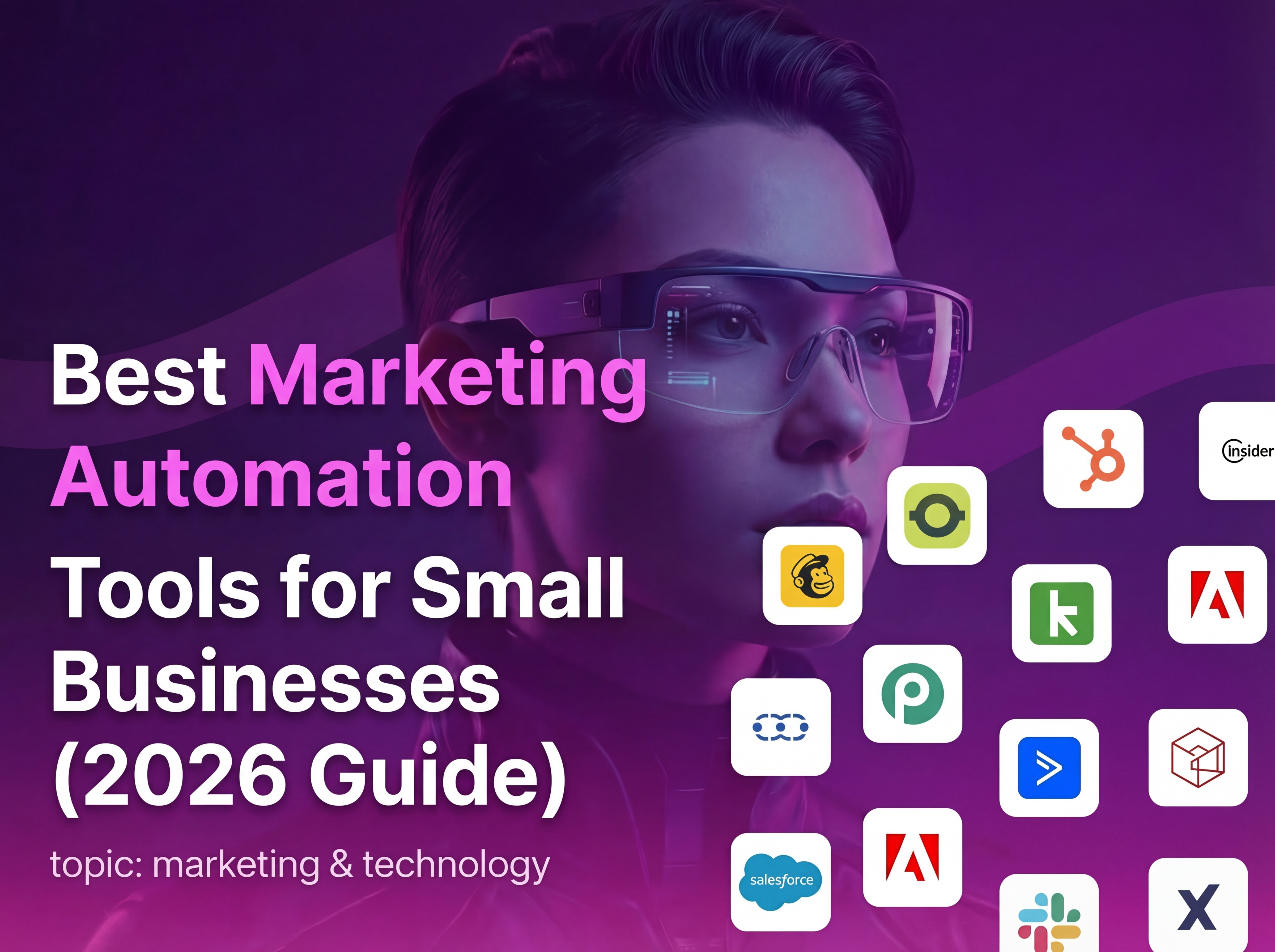
Stop doing everything manually. The best marketing automation tools for small businesses let you email, nurture, and convert leads while you sleep, here's exactly which ones are worth your money in 2026.
What Is Marketing Automation? (And Why Should You Care)
Marketing automation is software that handles repetitive marketing tasks for you, automatically. Think: welcome emails that fire the moment someone signs up, follow-up sequences that nurture leads over days or weeks, social posts scheduled in advance, and ad audiences that update in real time based on customer behaviour.
For small businesses, this is a game-changer. You don't have a team of 20 marketers. You have you and maybe a couple of people. Marketing automation gives you the leverage of a much bigger operation, without the payroll to match.
Why Small Businesses Can't Afford NOT to Automate
Time is your most valuable asset as a small business owner, and most of it is being eaten alive by tasks that don't actually need you.
According to research by Nucleus Research, marketing automation drives a 14.5% increase in sales productivity and reduces marketing overhead by 12.2%. Meanwhile, companies using automation to nurture leads generate 451% more qualified leads than those who don't.
That's not a nice-to-have. That's a competitive advantage. And right now, your competitors are either already using it or about to.
What to Look for in a Marketing Automation Tool
Before we look into specific tools, here's what actually matters when you're a small business choosing an automation platform. Don't get dazzled by features you'll never use:
Ease of use — you need to set it up and run it yourself, not hire a developer
Affordable pricing — ideally free to start, with scalable plans as you grow
Email automation at minimum — this is non-negotiable for any small business
CRM integration — so your sales and marketing data live in the same place
Analytics and reporting — you can't improve what you can't measure
Third-party integrations — it needs to talk to your existing tools (Shopify, WordPress, Zapier, etc.)
The Best Marketing Automation Tools for Small Businesses in 2026
We've cut through the noise. These are the tools that actually deliver for small businesses not enterprise platforms dressed up with a "SMB plan" that nobody can figure out.
1. HubSpot — Best All-in-One Platform
HubSpot is the gold standard and for good reason. It combines CRM, email marketing, landing pages, social scheduling, live chat, and detailed analytics in one place. The free plan is genuinely useful, not just a teaser.
What makes HubSpot exceptional for small businesses is its workflow builder, you can create automated email sequences triggered by specific actions (someone visits your pricing page, downloads a lead magnet, or abandons a form) without writing a single line of code.
The visual automation builder is clean and intuitive. You can see exactly what a contact will experience at every stage of their journey and tweak it based on real performance data. HubSpot's reporting is also best-in-class at this price point, so you'll always know exactly what's working.
Best for: Small businesses that want everything under one roof and are serious about growth.
Pricing: Free plan available. Paid plans start from £15/month.
Verdict: If you only pick one tool from this list, this is the one.
2. ActiveCampaign — Best for Advanced Email Automation
If email automation is your primary focus, ActiveCampaign is genuinely in a league of its own. Its visual automation builder is one of the most powerful on the market, allowing you to create highly personalised journeys based on contact behaviour, tags, scores, and custom fields.
You can build logic like: "If a contact opens email 1 but doesn't click, wait 2 days, then send a different version." Or: "If they visit the pricing page 3 times without buying, notify the sales team immediately." That level of intelligence at a small business price point is remarkable.
ActiveCampaign also includes a built-in CRM, sales pipeline management, and SMS messaging making it a surprisingly complete platform for a tool that started life as a pure email tool.
Best for: Service-based businesses, coaches, consultants, and anyone who relies heavily on email nurture sequences.
Pricing: From $15/month (Starter plan).
Verdict: The most sophisticated email automation on the market at an accessible price.
3. Mailchimp — Best for Beginners
Mailchimp is where most small businesses start and honestly, for good reason. It's intuitive, well-designed, and the free tier (up to 500 contacts) gives you enough to get started without risking a penny.
The drag-and-drop email builder is clean, the automation journeys cover the core use cases (welcome series, abandoned cart, re-engagement), and the audience segmentation has improved significantly in recent years. It won't blow your mind with sophistication, but it will absolutely get the job done when you're starting out.
One thing to note: Mailchimp's pricing scales quickly as your list grows, and the automation capabilities can feel limiting once you're ready to get more advanced. Think of it as your launchpad, not necessarily your forever home.
Best for: New businesses, e-commerce brands, and anyone who wants a simple entry point.
Pricing: Free up to 500 contacts. Paid from $13/month.
Verdict: Perfect starting point. Plan to outgrow it.
4. Klaviyo — Best for E-Commerce
If you run an online store, Klaviyo is arguably the most powerful marketing automation tool available at a small business price point. It integrates deeply with Shopify, WooCommerce, and BigCommerce pulling real purchase data to drive automation that actually converts.
Klaviyo's pre-built flows, abandoned cart, browse abandonment, post-purchase, win-back are set up in minutes and consistently generate ROI that makes the monthly fee feel like a steal. Average Klaviyo users report 20-30x ROI on their email channel alone. That's not marketing jaargon. That's real money.
The segmentation is extraordinarily powerful. You can target customers who spent over £100, bought a specific product, haven't purchased in 90 days, or opened your last 3 emails all with a few clicks. That precision is what separates a 2% conversion rate from a 12% one.
Best for: E-commerce businesses on Shopify or WooCommerce.
Pricing: Free up to 250 contacts. Paid from $20/month.
Verdict: Non-negotiable for e-commerce. Nothing else comes close at this price.
5. Brevo (formerly Sendinblue) — Best Value for Money
Brevo is the dark horse of this list. It packs email marketing, SMS campaigns, WhatsApp messaging, live chat, and a built-in CRM into a single platform with a genuinely generous free plan that includes unlimited contacts (you pay per email send, not per contact).
For small businesses watching every penny, Brevo's pricing model is a breath of fresh air. Most tools charge based on your contact list size, meaning the more you grow, the more you pay just to hold the contacts. Brevo flips this, making it significantly cheaper for businesses with large lists but moderate send volumes.
The automation workflows are solid, covering all the essentials, and the multi-channel capability (email + SMS + WhatsApp in one sequence) is genuinely rare at this price point.
Best for: Budget-conscious small businesses, local businesses, and those who want multi-channel messaging.
Pricing: Free plan available (300 emails/day). Paid from $9/month.
Verdict: Exceptional value. Underrated by most. Worth serious consideration.
6. Kit (formerly ConvertKit) — Best for Creators and Personal Brands
If you're a freelancer, coach, consultant, or content creator, Kit was essentially built for you. It strips away the bloat and focuses on what matters: growing your audience, delivering valuable content, and selling digital products or services.
The subscriber tagging and segmentation system is clean and logical. You can build automated sequences based on what people subscribe to, what they click, and which products they've purchased. It also has a built-in commerce feature so you can sell digital downloads directly without needing a third-party tool.
The email editor is beautifully simple focused on plain-text, high-deliverability emails that feel personal rather than like marketing blasts. Because they are.
Best for: Bloggers, podcasters, coaches, and solo entrepreneurs building an audience.
Pricing: Free up to 10,000 subscribers. Paid from $25/month.
Verdict: The tool creators actually love using. Simple, elegant, and conversion-focused.
7. Zapier — Best for Connecting Everything Together
Zapier isn't a marketing automation tool in the traditional sense, but it might be the most powerful one on this list. It connects over 7,000 apps and automates workflows between them, acting as the glue between your entire marketing stack.
Think: when someone fills out a form on your website, Zapier can automatically add them to your CRM, tag them in your email tool, send a Slack notification, and add a row to your Google Sheet, all simultaneously, all without you touching anything. That's automation that saves hours every single week.
The real power of Zapier is that it makes every other tool on this list better. Use it alongside HubSpot or ActiveCampaign to build automation workflows that no single tool could achieve alone.
Best for: Any small business that uses multiple tools and wants them to work together seamlessly.
Pricing: Free plan (100 tasks/month). Paid from $19.99/month.
Verdict: Essential infrastructure for any serious marketing operation.
How to Choose the Right Marketing Automation Tool for Your Business
Stop trying to pick the "best" tool. Pick the right tool for where you are right now.
Here's a simple decision framework:
You're just getting started and have under 500 contacts? → Start with Mailchimp or Brevo (both free)
You run an online store on Shopify? → Klaviyo. Full stop.
You're a service business that relies on leads and consultations? → HubSpot or ActiveCampaign
You're a creator, coach, or personal brand? → Kit
You want advanced email sequences with deep personalisation? → ActiveCampaign
You use 5+ different tools and nothing talks to each other? → Add Zapier immediately
The worst thing you can do is spend three weeks researching the "perfect" tool and never actually implementing anything. Pick one. Set it up. Run it for 90 days. Then optimise.
Common Marketing Automation Mistakes Small Businesses Make
Knowing which tools to use is only half the battle. Here's what separates businesses that see results from those who set up automation and wonder why nothing changed:
Automating before you have a strategy. Automation amplifies what you already have, if your messaging is unclear or your offer is weak, automation will just send bad content faster.
Setting it and forgetting it. Automation needs to be reviewed regularly. Sequences go stale, offers change, and what worked 12 months ago might now be actively hurting conversions.
Over-automating. Nobody wants to feel like they're talking to a robot. The best automation feels personal. Use your audience's name, reference what they actually did, and write like a human being.
Ignoring deliverability. The most beautifully written email sequence is worthless if it lands in spam. Use a verified sending domain, keep your list clean, and monitor your open rates as a health signal.
Not testing. Every subject line, send time, and email sequence should be A/B tested. Even small improvements compound dramatically over time.
Frequently Asked Questions About Marketing Automation for Small Businesses
What is the best free marketing automation tool for small businesses?
HubSpot offers the most complete free plan, covering CRM, email marketing, forms, and basic automation. Brevo is the best free option if you have a large contact list but send emails infrequently.
How much should a small business spend on marketing automation?
Most small businesses can get significant results with tools costing between 15–15–50/month. Start on a free plan, prove the ROI, then upgrade. A well-configured $30/month automation stack can generate thousands in additional revenue.
Is marketing automation only for big businesses?
Absolutely not. In fact, small businesses benefit more proportionally, because they have fewer people and less time. Automation gives a solo founder the marketing output of a team.
How long does it take to set up marketing automation?
A basic welcome email sequence can be live in under an hour. A comprehensive nurture funnel with segmentation and follow-up sequences typically takes 1–2 weeks to build properly. The time investment pays back within weeks.
What's the difference between email marketing and marketing automation?
Email marketing is sending emails to a list. Marketing automation is sending the right email to the right person at the right time, triggered by their specific behaviour, not a broadcast schedule. It's the difference between a megaphone and a personal conversation.
Can marketing automation replace my sales team?
No — and you shouldn't want it to. Automation handles the top and middle of the funnel (awareness, education, nurture) so your sales team only speaks to warm, qualified leads who are ready to buy. It makes your sales team more effective, not redundant.
Real talk:
Marketing automation isn't a luxury. For small businesses in 2026, it's the infrastructure that separates brands that scale from those that plateau.
The tools on this list aren't complicated. They don't require a technical team or a six-figure budget. They require one thing: that you actually implement them.
Start simple. Pick one tool. Set up a welcome sequence. Automate your follow-ups. Measure what happens.
Then build from there.
And if you're not sure where to start, or you want someone to build the whole system for you that's exactly what we do at RBRANDR. We design and implement marketing automation systems that generate leads, nurture them, and convert them on autopilot.
Book a free consultation and let's talk about what your automation stack should look like.